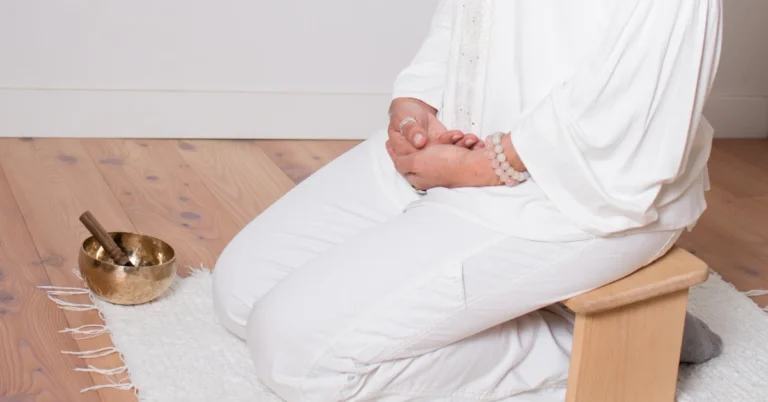


The inner critic is not loud all the time. It tends to be loudest when I am already tired, already stretched, already behind on something that matters. It shows up in the moments when I am least equipped to argue back, and when I do try to argue back, it just gets louder. Self-compassion meditation does not ask you to win that argument. It asks you to step out of it entirely and offer yourself the same quality of attention you would give to someone you care about who was struggling. This article covers how I use a self-compassion script to do that, what the practice actually involves, and how it has changed the way I handle the harder parts of my own thinking.
The practice is simple enough to do in ten minutes and deep enough to keep working with for years. It does not require a particular belief system or any prior meditation experience. It requires only a willingness to be somewhat less harsh with yourself than you might default to being, which is both easier and harder than it sounds depending on the day.
A moment of self-compassion can change your entire day. A string of such moments can change the course of your life.
Christopher Germer
Germer has spent decades researching self-compassion alongside Kristin Neff, and this observation is drawn from clinical work rather than from inspiration alone. The shift from self-criticism to self-compassion is not a soft or passive move. It is a practiced skill, and like any skill it improves with consistent use. Let me walk through how I approach it.
Preparing for Self Compassion Meditation Script
The preparation for a self-compassion session is less about logistics than about intention. You are not just finding a quiet spot and pressing play on a recording. You are deciding to treat yourself well for a fixed amount of time, which sounds simple but can require more deliberateness than expected when the inner critic is running the commentary. Here is how I set up for sessions where I am specifically working with self-criticism.
Choosing a Quiet Space
The physical environment matters more than I initially thought. Self-compassion practice requires a degree of inner openness that is harder to access when the space around you is stimulating or associated with tasks and obligations. I practice in a room that is separate from my workspace, and on days when that is not possible, I use a corner of a room with my back to the desk. Finding a genuinely quiet space tells the part of me that is in task-completion mode that something different is happening now. That signal matters, especially when the inner critic is tied to performance and productivity concerns.
Setting the Intention
Before I start, I take a moment to name what I am bringing into the session. Not to analyze it or solve it, just to acknowledge it. Today the inner critic has been focused on a conversation I handled badly. Today I am practicing for the part of me that has been trying hard in difficult circumstances and has not stopped to notice that. Naming what is present gives the compassion practice somewhere specific to land rather than floating in abstraction. It also helps me track, over time, what kinds of situations the inner critic activates most reliably.
Determining the Duration
Five minutes of genuine presence in this practice is worth more than twenty minutes of distracted going-through-the-motions. I start with what I can realistically sustain rather than what sounds like the right amount. On most days that is between ten and twenty minutes. On days when the inner critic is particularly loud, I find that shorter sessions are actually more effective because they do not exhaust me before I reach the loving-kindness section. The session length can grow over time as the practice becomes more familiar.
What matters most at the preparation stage is removing the two main barriers that prevent people from starting: a belief that they need more time than they have, and a belief that they need to feel calm already before beginning. You do not need either. The practice works regardless of what emotional state you bring to it. In fact, it tends to work better when you bring something real rather than waiting for a moment of peace that may not arrive.
The Meditation Process Of Self Compassion Meditation Script

The session itself moves through four phases. Each phase builds on the one before it, which is why the order matters. Starting with the loving-kindness phrases before the body has settled rarely works. Moving in sequence from physical to mental to emotional to relational gives the practice a reliable structure that holds even when the content is difficult.
Body Relaxation
The first phase is physical settling. I start with a few slow, deliberate breaths and then scan through the body for held tension. When the inner critic has been active, I almost always find tension in the jaw, the throat, and the upper chest. These are the places where self-judgment lives physically. Naming the tension and breathing into it is not dramatic, but it signals to the nervous system that the threat response is not needed right now. The body relaxation phase is not separate from the self-compassion work; it is the beginning of it, because you cannot extend genuine kindness to yourself while your body is braced for attack.
Mindfulness Practice
Once the body has settled somewhat, I bring attention to the present moment by staying with the breath for a few minutes without trying to change it or use it for a particular purpose. This is different from the breath work in the settling phase. Here the breath is just something to observe. The mindfulness interval is what creates space between the experience and the self-critical narrative about the experience. The inner critic typically operates by fusing what happened with what it means, and a few minutes of non-judgmental breath awareness loosens that fusion enough to work with.
Loving-Kindness Phrases
After physical settling and a brief mindfulness interval, I work with loving-kindness phrases directed toward myself. I choose phrases that are simple and that do not feel performative or forced. The ones I return to most often are:
- May I be kind to myself in this moment
- May I hold this difficulty with care
- May I be patient with what is hard
- May I give myself what I need today
I say them silently and slowly, giving each phrase a few breaths before moving to the next. The feeling does not always arrive immediately. Sometimes repeating the phrases feels mechanical at first. That is normal. The practice is in the repetition, not in producing the right feeling on demand. The warmth often arrives a few minutes in, once the body and mind have settled enough to receive it.
Visualizations for Compassion
The final phase uses a brief visualization to anchor the feeling of self-compassion in something tangible. I often imagine placing a hand on my chest and offering warmth to whatever is tender there. Other times I picture myself at a younger age, before the self-critical voice was as developed as it is now, and extend care to that version of myself rather than to my current self directly. This slight distance can make compassion easier to access when the inner critic is arguing that the current self does not deserve it. However you visualize it, the goal is to make the quality of care feel real for a moment rather than purely conceptual.
Deepening Self Compassion Meditation Script

The foundational session format gets you started. Deepening the practice over time involves adding techniques that address specific dimensions of self-criticism rather than self-criticism in general. These are the three I have found most useful for working with an active inner critic.
Affirmations for Self-Acceptance
After months of working with loving-kindness phrases, I began incorporating affirmations that specifically address the areas my inner critic attacks most often. These are not generic positive statements. They are specific, honest, and rooted in what I actually believe on better days. The ones that have been most useful for me are:
- I am allowed to make mistakes and still deserve care.
- My effort matters even when the outcome falls short of what I intended.
- I do not have to earn rest or kindness by achieving something first.
Cultivating Inner Kindness
Building the capacity for inner kindness as a sustained orientation rather than a session-specific practice is a longer project. Here are three techniques I use to work on it beyond formal meditation:
- When I notice the inner critic activating during the day, I pause and ask what I would say to a close friend in the same situation. Then I say that to myself instead.
- I keep a brief written log of moments when I extended care to myself in some way, however small. Reading it back on harder days provides a concrete record that the capacity exists.
- I practice the loving-kindness meditation on behalf of others first, working outward from people I find it easy to care for, and then turn the same quality of attention back toward myself at the end of the session.
Forgiveness Exercise
The inner critic often holds specific grievances, things I did or did not do, choices I made that I regret, ways I fell short of my own standards. A forgiveness practice within the meditation addresses these directly. Some approaches I use:
- Writing out what I am holding against myself in specific terms, reading it once, and then writing a response from the perspective of a compassionate witness who has the full context.
- During the session, visualizing the specific situation the inner critic is focused on and offering it the same loving-kindness phrases I use for general practice.
- Naming the emotion underneath the self-criticism, often disappointment, shame, or fear, and staying with it for a few breaths without trying to resolve it. Allowing the emotion without judgment is itself a form of self-compassion.
Forgiveness toward myself does not mean excusing actions that caused harm or abandoning accountability. It means releasing the sustained self-punishment that continues long after accountability has been taken. The inner critic tends to keep the punishment running indefinitely. Forgiveness practice gives it a different ending.
Regular Practice Tips For Self Compassion Meditation Script

Building a consistent self-compassion practice when you have an active inner critic involves a particular challenge: the inner critic will comment on the practice itself. It will find the affirmations embarrassing, the visualization sentimental, and the consistency inadequate. Here is how I have maintained the practice despite that commentary.
Creating a Routine
I practice at the same time each day, morning for most of the week and occasionally evening when I need to address something that built up during the day. Anchoring the session to a specific point in the day removes the question of whether today is the right time, which the inner critic is delighted to answer with “not yet.” I keep the session length fixed at the minimum I know I can complete, which removes the inner critic’s ability to argue that the session is not long enough to count. A shorter practice done consistently is worth considerably more than a longer one done sporadically. Our guide on 15-minute mindfulness practice offers a useful parallel structure if you want a complementary session format.
Tracking Progress
I keep a brief record after sessions, not an elaborate journal but two or three sentences about what I brought into the session and what shifted, even slightly. Over weeks, patterns emerge. I can see which techniques work for which kinds of self-critical content. I can also see that the sessions where I felt least engaged at the start sometimes produced the most noticeable relief by the end, which has been useful evidence against the inner critic’s prediction that starting when I do not feel like it is pointless. The record also makes visible the cumulative nature of the practice, which is otherwise invisible when you are inside any single session.
Overcoming Challenges
The main challenges I have encountered and worked through are these: the practice feeling artificial, the inner critic commenting on the practice while I am doing it, and stretches of days where the habit slips. For the artificiality issue, I remind myself that most learned skills feel artificial before they become natural, and that the feeling of going through the motions is not evidence that nothing is happening. For the inner critic commenting during the session, I have found it useful to note it as content without treating it as instruction, the same way you might note a sound outside without getting up to investigate it. For slipped habit streaks, I return to the shortest version of the practice and start again from there without any commentary on the gap.
Adapting the Self Compassion Meditation Script for Groups

Leading a group through a self-compassion session is different from doing it alone. The inner critic is often more defended in a group setting because people are aware of being observed. Moving slowly and providing concrete instructions helps. Here is a sequence I have used with small groups:
Before beginning, I explain briefly what self-compassion means as a practice: not positive thinking, not self-indulgence, but meeting your own experience with the same care you would offer someone else. That framing matters because many people arrive with a belief that being kind to themselves is somehow at odds with high standards or accountability.
- Begin with two minutes of guided breathing, slow enough that the room’s pace settles before anything else happens.
- Invite participants to call to mind something they have been critical of themselves about recently. Not the worst thing, just something current and real.
- Guide a brief body awareness scan, naming jaw, throat, and chest as places to notice and soften.
- Lead through three or four loving-kindness phrases slowly, leaving several breaths between each one.
- Close with one minute of quiet before inviting people back. Give anyone who wants to share a moment to do so, but do not require it. The practice is complete whether or not it is spoken about.
Group dynamics vary considerably, and what creates safety in one context may not work in another. The core structure above is flexible enough to adapt. The most important thing is to move at a pace that gives the body time to settle, which is usually slower than it feels natural to go when leading a group.
Scientific Research Findings For Self Compassion Meditation Script

The research on self-compassion as a psychological construct is substantial and growing. Kristin Neff’s foundational work established self-compassion as a measurable psychological variable with distinct components: self-kindness, common humanity, and mindfulness. Studies across her lab and others have found consistent associations between self-compassion and lower rates of anxiety, depression, perfectionism, and burnout. These associations hold across cultures and age groups, and longitudinal work suggests the relationship is directional rather than merely correlational.
Research on mindfulness meditation more broadly has found that consistent practice produces measurable changes in self-reported stress, emotional reactivity, and physiological markers of arousal. A study published in PubMed found that a neuroscience-based mindfulness meditation program led to improved mindfulness, self-compassion, and mood state across participants. This is consistent with the clinical experience of practitioners and with what I have noticed in my own practice over time.
The Greater Good Science Center at UC Berkeley has also documented links between self-compassion and reduced self-criticism, improved resilience, and greater emotional stability under stress. What the research consistently shows is that self-compassion is not a fixed trait but a capacity that responds to practice, which means the effort of working with it regularly has a documented and predictable payoff.
References:
- Effects of a Neuroscience-Based Mindfulness Meditation Program – PubMed
- What is Compassion Meditation? (+ Mantras and Scripts)
- PDF FIERCE SELF-COMPASSION Dr. Kristin Neff – Greater Good
Resources for Further Learning Of Self Compassion Meditation Script

If you want to go deeper with the practice, these are the resources I have found genuinely useful rather than just frequently mentioned. I have worked with each of these alongside the body scan and loving-kindness practices described in this article. For a related skill, the body scan for self-awareness is a strong complement to self-compassion work because it builds the physical attunement that the loving-kindness practice needs to be more than conceptual.
Books
The research-backed books I return to most often in this area are:
- The Mindful Self-Compassion Workbook by Kristin Neff and Christopher Germer
- Self-Compassion: The Proven Power of Being Kind to Yourself by Kristin Neff
- The Self-Compassion Skills Workbook by Tim Desmond
Online Courses
If a structured multi-week program is more useful to you than a standalone book, these are the two I would point to:
- Mindful Self-Compassion by Kristin Neff and Christopher Germer, an eight-week evidence-based program with guided practices and weekly themes.
- The Science of Self-Compassion from the University of California, Berkeley, which covers the research and provides practical exercises across several weeks.
Apps
Two apps I have used regularly for guided self-compassion sessions:
- Headspace includes dedicated self-compassion courses and standalone sessions that follow the loving-kindness format.
- Insight Timer has a wide range of free guided meditations on self-compassion, including sessions from researchers and teachers associated with the formal Mindful Self-Compassion program.
Wherever you start, the most important thing is to start smaller than you think you need to and then let the practice grow from consistent use rather than from ambitious intent. The inner critic will have opinions about your progress. The practice is learning to hold those opinions lightly rather than treating them as accurate assessments of what you are capable of.
FAQ
What is a self compassion meditation script and how is it different from general meditation?
A self-compassion meditation script is a structured practice that directs kindness, care, and non-judgment specifically toward yourself. Unlike general mindfulness meditation, which focuses on present-moment awareness without a particular emotional direction, a self-compassion script has a specific orientation: to meet your own experience, including your failures, your struggles, and your inner critic, with the same care you would offer a friend. It draws on the same attentional skills as mindfulness but applies them in a specific relational direction.
Is this practice useful even for people who are not facing a specific difficulty?
Yes. Self-compassion practice is beneficial as a general orientation rather than only as a response to crisis. Regular practice tends to reduce baseline self-criticism, improve emotional resilience, and make it easier to respond to difficulty with care rather than self-attack when it does arise. People with relatively functional inner critics benefit from the practice just as much as those dealing with more severe self-criticism.
What techniques are typically included in a self-compassion script?
Common techniques include body relaxation to release physically held tension, breath-centered mindfulness to create space from self-critical thought, loving-kindness phrases directed toward oneself, visualization exercises that make the feeling of self-care tangible, and affirmations that address specific patterns of self-criticism. These work together to move the practice from intellectual understanding of self-compassion to embodied experience of it.
How regularly should I practice, and what changes over time with consistent use?
Daily practice is most effective, even in short sessions of ten to fifteen minutes. Over weeks, the main changes most people notice are a faster ability to access the feeling of kindness toward themselves, a reduced grip of the inner critic, and a greater capacity to meet difficult emotions without immediate self-judgment. Over months, the orientation tends to generalize beyond formal sessions into everyday responses. The practice does not eliminate the inner critic, but it reduces its authority.
If this article on self compassion meditation script was useful, follow us on Pinterest for more meditation and mindfulness guides.