
I spent a few months trying astral projection recordings, partly out of curiosity and partly because I was going through a period of chronic stress and not sleeping well. I want to be upfront about where I landed: I do not think I left my body. What I did experience was some of the deepest physical relaxation I have had from any guided practice, a consistent improvement in sleep quality when I used the recordings before bed, and a better sense of where tension lives in my body. That may not be what you are hoping to hear if you came here looking for confirmation of OBE experiences. But it is what actually happened, and I think it is worth describing honestly before I get into the techniques.
What Astral Projection Guided Meditation Actually Is
Definition and History
Astral projection is described as the practice of consciously directing one’s awareness outside the physical body. The concept appears in various forms across multiple traditions: the ancient Egyptian concept of the ba, the Theosophical writings of the 19th century, certain interpretations of yogic states in the Hindu tradition, and modern spiritualist communities. Whether any of this involves an actual physical separation of consciousness from the body, or whether it is a particular type of altered state produced by deep relaxation and specific attentional techniques, is not settled by research. The subjective experiences reported by practitioners are real and often vivid. Their metaphysical interpretation is a separate question.
The modern interest in astral projection as a practice rather than a mystical phenomenon gained momentum in the 20th century through writers like Robert Monroe, whose books documented his experiences and proposed techniques for inducing them. Monroe’s work introduced the term “out-of-body experience” as a more neutral description than astral projection, and some of the guided recordings you find today are based on his methods or variations of them. Others draw more directly from older spiritual traditions. The recordings vary considerably in tone, from clinical and technique-focused to heavily mystical in framing.
The recordings I am describing here, including the one embedded above, sit somewhere in the middle. They guide you through a deep relaxation process and then use visualization techniques designed to produce the sensation of floating or moving beyond the body. Whether you interpret what follows as literal astral travel, a hypnagogic experience, or simply deep relaxation is up to you. The technique works, in the sense that it produces a reliably deep physical and mental relaxation, regardless of which frame you bring to it.
What Gets Reported and What to Be Skeptical About
The commonly reported benefits of astral projection practice include increased self-awareness, reduced fear of death, expanded sense of perspective, improved sleep, and a general sense of mental spaciousness. The first and last of these align reasonably well with what is reported from other deep relaxation and meditation practices. The claims about accessing higher realms, receiving information that could not have been obtained normally, or having verifiable experiences while out of the body are where I would encourage skepticism. The anecdotal reports of these experiences are interesting and sometimes compelling. The controlled evidence for them is not there.
What I found genuinely useful about astral projection recordings was not anything that required a metaphysical framework. The extended body relaxation sequences in these recordings are among the most thorough I have encountered in any guided practice. The progressive attention to physical sensation, combined with the very deliberate pacing, produces a quality of release in the body that I struggle to replicate through standard body scan recordings alone. That is worth something on its own terms, even if you set aside the astral dimension entirely.
The Process: What These Recordings Actually Guide You Through

Having listened to a number of these recordings over several months, the structure is fairly consistent. Understanding what to expect before you start makes the sessions more productive and keeps you from being disoriented by instructions you were not prepared for.
Relaxation Phase
Most astral projection recordings spend considerably more time on the initial relaxation phase than standard meditation sessions do. This is the part I have found most consistently useful and have adapted into my own non-astral-projection practice. The typical sequence involves lying down, deliberately slowing the breath, and then systematically releasing tension from each part of the body. The recordings tend to spend more time on this than a standard body scan meditation would, sometimes 20 minutes or more just on the physical settling before any visualization begins.
The progressive muscle relaxation technique used in many of these recordings, tensing and then releasing muscle groups, is a well-documented method for achieving deep physical relaxation. It is not specific to astral projection; it is used in clinical settings for anxiety, insomnia, and chronic pain management. The fact that it appears in these recordings is not coincidental. You need a thoroughly relaxed body before the attentional transition the recordings are aiming for can happen, and this technique is reliable at getting there.
Visualization Phase
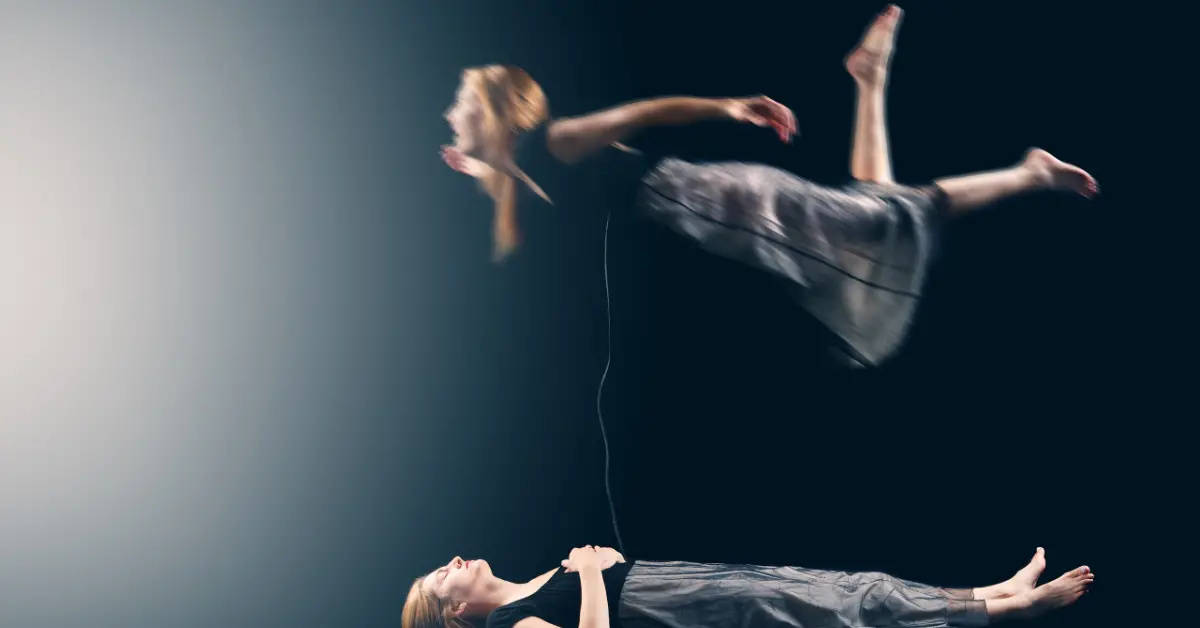
Once the body relaxation is established, most astral projection recordings move into a visualization phase designed to produce the sensation of leaving the body. Common techniques include the rope method, where you visualize a rope above you and imagine pulling yourself upward; the rolling technique, where you imagine rolling out of your physical body to one side; and the float method, where you visualize yourself slowly rising above your body. The guide’s voice during this phase is typically slower and quieter than during the relaxation phase, with longer pauses.
What I noticed during this phase was something that I would describe as a hypnagogic state: the transition between waking and sleep where the body feels heavy or weightless and visual imagery becomes more vivid and less controlled. This is a well-documented neurological phenomenon and is probably what is happening in most successful astral projection attempts, rather than a literal physical separation of consciousness from the body. Whether that matters depends on what you are looking for from the practice. As an experience in itself, the hypnagogic state is unusual and worth knowing about even if you are not interested in the mystical framing.
Techniques: What I Tried and What I Skipped

Not everything in astral projection practice is equally accessible or equally useful. Here is what I engaged with, what I found worthwhile, and what I left alone.
Voice-Guided Sessions: Useful, With Caveats
I used recorded voice guidance rather than trying to direct the practice myself, particularly for the relaxation phase. A skilled guide can hold a specific pacing and tone that you cannot sustain for yourself when you are also the person trying to relax. The best recordings I found had voices that were slow, unhurried, and genuinely quiet rather than artificially soothing in a way that draws attention to itself. The voice should recede into the background of your awareness as the session progresses; if you are still paying conscious attention to the voice rather than following it automatically, the recording is not working well for you.
One caveat about voice guidance in this genre: some recordings escalate into increasingly elaborate claims about what you are experiencing or are about to experience, in a way that starts to feel more like suggestion than guidance. “You are now leaving your physical body” stated as a fact rather than as an invitation is an example. I found these recordings less useful. Good guidance supports your own experience; it does not tell you what your experience is.
Music and Binaural Audio: Neutral
Many astral projection recordings include binaural beats, which are audio frequencies designed to influence brainwave states. The claimed mechanism is that slightly different tones in each ear produce a perceived third frequency in the brain that corresponds to particular states like theta or delta waves. The research on binaural beats is mixed; there is some evidence of modest effects on relaxation and focus, nothing as dramatic as the promotional language around them suggests. I tried recordings with and without binaural beats and did not notice a significant difference in the quality of the sessions. If the music helps you settle, use recordings with it. If it is distracting, find recordings without it.
Nature sounds and ambient music work similarly to what they do in other meditation contexts: they mask environmental noise and provide a consistent audio backdrop that signals to the nervous system that this is a different kind of attention than ordinary waking activity. Whether they do anything beyond that is unclear to me from my own experience.
What I Skipped
I skipped the more intensive practices that involve sleep deprivation, alarm-based wake-back-to-bed protocols, and extended multi-hour sessions. These approaches appear frequently in astral projection communities and are designed to facilitate the hypnagogic state by catching the nervous system in the transition between sleep stages. They may be effective for the people they work for. For me, disrupting sleep to have an unusual experience seemed like the wrong trade-off. I was already using these recordings partly to improve sleep quality, and sacrificing sleep to pursue a particular experience within the practice felt contradictory. If your primary interest is the relaxation and body awareness benefits rather than the OBE component, the standard guided recordings before sleep are sufficient and less disruptive to your rest.
Deepening the Practice: What Actually Worked for Me

After a few months of irregular use, the patterns that seemed to matter most were fairly mundane.
Using the Breath as an Anchor Throughout
When the visualization instructions started to feel abstract or ungrounded, I found that returning attention to the breath for a few cycles before continuing was more stabilizing than trying to push through. The breath keeps you anchored to the body, which is useful even when the explicit goal of the session is to feel less anchored to the body. A practice that leaves you feeling genuinely disoriented or anxious is not serving you. Returning to breath and physical sensation is always an available corrective. For people who already have an established body scan practice, astral projection recordings build on that foundation naturally; the body awareness you develop through scan work makes the initial relaxation phase significantly easier to move through.
Setting an Intention Before Starting
I found it useful to decide before pressing play whether I was using the recording for relaxation and sleep, for body awareness work, or to actually attempt the OBE experience. These are different orientations, and starting without a clear one tended to make the session feel scattered. When I was using it for sleep, I did not try to stay awake through the full visualization sequence and did not feel that I had failed if I fell asleep before reaching that point. When I was using it for the experience itself, I kept the room slightly cooler and sat up rather than lying down, which made it easier to remain awake through the deeper states.
Who Should Probably Skip These Recordings
I want to be direct about this because I have seen it underemphasized in other coverage of astral projection practice. If you have a history of dissociation, depersonalization, derealization, psychosis, or significant trauma, these recordings are not a good starting point without professional guidance. The techniques are specifically designed to produce altered states of awareness in which the usual sense of being located in the body loosens. For people with a stable relationship to their own sense of self, this loosening is temporary and interesting. For people with a fragile or disrupted sense of self, it can be destabilizing in ways that are disproportionate to any benefit the practice might offer. Consult a therapist or psychiatrist if you are uncertain whether this applies to you before starting a regular practice with these recordings.
FAQ
Is astral projection guided meditation actually different from regular deep relaxation?
Structurally, the relaxation and body awareness portions of astral projection recordings are similar to other deep relaxation practices. The difference is in the visualization phase, where the instructions specifically guide you toward the sensation of leaving the physical body. Whether anything metaphysically distinct is happening during that phase, or whether it is a particular type of hypnagogic experience produced by the technique, is a question I cannot answer definitively from my own experience. What I can say is that the physical relaxation these recordings produce is genuine and useful regardless of what you believe about the OBE component.
Is astral projection guided meditation safe, and are there people who should avoid it?
For most people with a stable sense of self and no history of psychosis, dissociation, or significant trauma, short guided sessions are low-risk. The altered states produced are temporary and mild compared to what the more committed practitioners describe. That said, I would be clear that people with a history of dissociation, depersonalization, or derealization should be cautious and ideally consult a mental health professional before starting. These techniques are specifically designed to loosen the ordinary sense of being grounded in the body, which is useful for some people and potentially problematic for others.
What techniques are used in astral projection guided meditation, and which ones actually work for relaxation?
The main techniques are deep breathing, progressive muscle relaxation, and visualization methods like the rope technique or the float method. For the relaxation and body awareness benefits, the breathing and progressive muscle relaxation sequences are the most consistently useful parts and transfer well to other contexts. The visualization techniques aimed specifically at the OBE experience are more variable in their effects and require more practice to produce anything notable. Starting with the relaxation focus before attempting the full OBE sequence is a more sustainable approach for most beginners.
How long does it take to have any notable experience with astral projection practice?
It varies considerably, and the honest answer is that many people practice for weeks without having an experience they would describe as an OBE. What tends to happen more reliably and more quickly is a significant improvement in the quality of deep relaxation and a better sense of body awareness. If you have been practicing regularly for a month and are primarily noticing these benefits rather than OBE experiences, that is a reasonable and useful outcome on its own. Whether to continue toward the OBE component specifically is a question only you can answer based on your own goals for the practice.
If you found this article about astral projection guided meditation useful, follow us on Pinterest so you do not miss any more meditation notes.